Product
Platform Updates: Visitor Maps and Behavior-Based Personalization

We have two big updates this week: first, visitor maps are now part of Web Analytics. Second, Personalization can now reference what a visitor has already interacted with on your site, not just the page or campaign that brought them in.
The first makes it easier to see where demand is taking shape, and the second lets you give second-time visitors a personalized experience that reflects what they have already explored.
Let's dive in.
Visitor Maps Are Here
Web Analytics now includes a visitor map, which breaks down U.S. traffic state by state. Select a state to see the city-level visitor counts behind it, then return to the national view when you are ready to compare the full picture again.

The visitor map in Web Analytics, showing state-level traffic and a visitor-count legend.
The visitor map gives you a simpler way to answer the question, “Where are people coming from?” It's the same location data you've always had access to, now visualized as a map you can click through.
Read the Web Analytics documentation for the full walkthrough.
Personalization Based on a Visitor's Past Behavior
Experiments are much more useful for personalization when they can account for what a visitor has already done. A visitor who viewed /pricing can now carry that signal into a later visit. A personalization property rule can set visited_pricing: true from the page view, then use that property to decide which message, page change, or redirect the visitor receives on a future full page load.
That changes the shape of personalization. Teams can use the visitor context available on the current page, including campaign, location, device, referral source, and new-versus-returning status. They can also use properties their event stream has accumulated about that visitor over time. This means it's possible to:
Show a follow-up message to someone who has already explored a key page.
Match a landing-page experience to the campaign, device, location, or referral context that brought a visitor in.
Recognize a returning visitor based on the actions they took weeks earlier, not just the URL they loaded today.
Send a matching visitor to a different destination page when that is more useful than changing content in place.
The workflow starts with a decision about what a visitor should see. Use an experiment when the team needs to learn which experience works better. Use Personalization when the team already knows, and visitors who match specific properties will receive the treatment every time, with no traffic split, conversion metric, or statistical winner required.
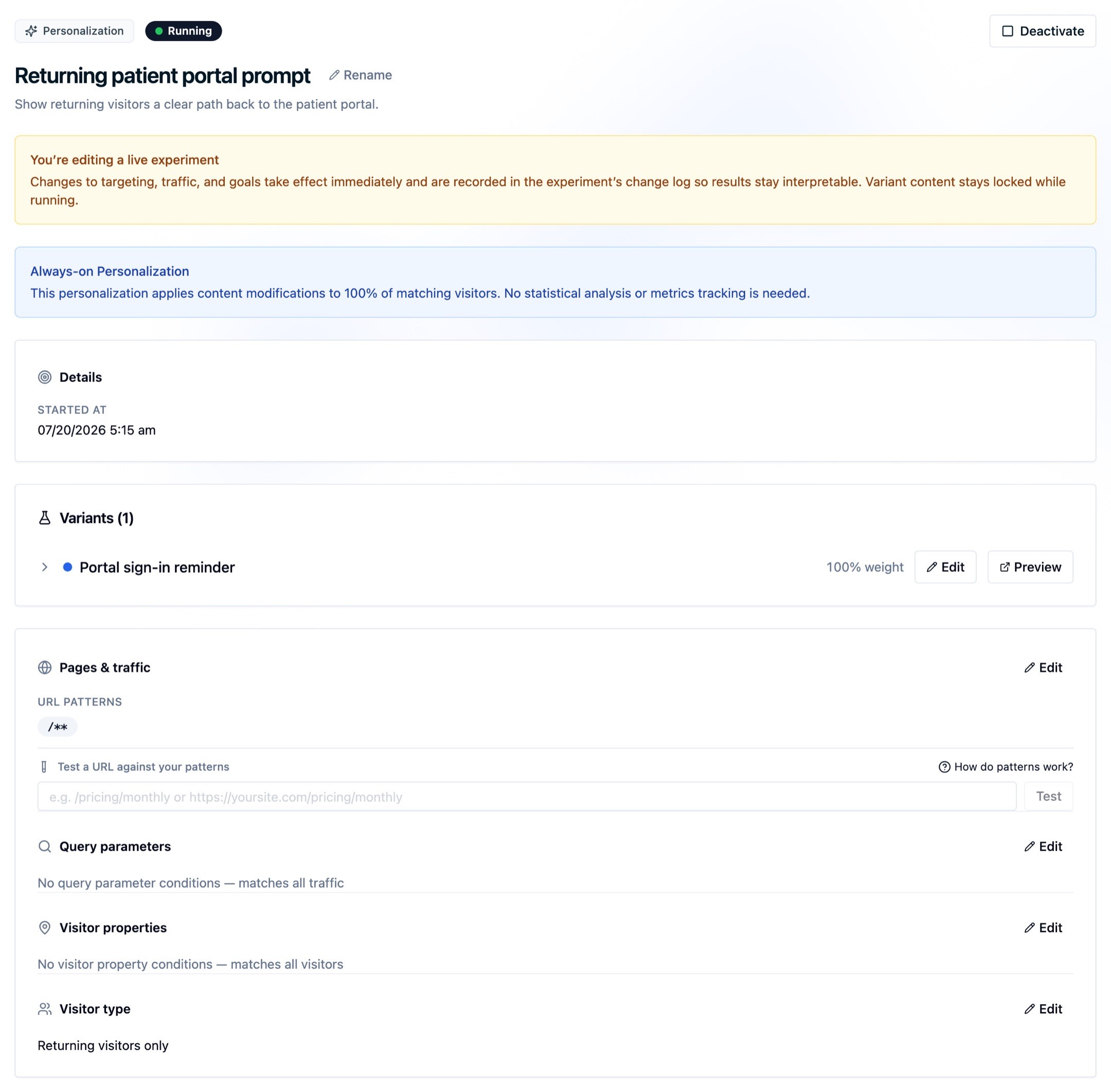
A running Personalization rule in Experimentation, showing its always-on delivery, full matching-visitor traffic, and targeting controls.
Personalization uses the same Experimentation runtime, consent controls, and treatment tools as an A/B test. Teams can make DOM changes or redirects, or read visitor context from the JavaScript SDK and render the experience in their own application code. A newly accumulated property is available on the visitor's next full page load, which keeps the model straightforward: an action becomes context for the next decision.
Because accumulated properties are delivered to the browser, they must be safe to expose there. Do not use protected health information, credentials, or other confidential data.
Read more about Content Personalization.
Also New
Destination configuration history. The new destination history view lets teams compare a destination's configuration across published versions, see which properties changed and when each version was published, and view the publisher when available. The Data Sharing Report remains the place to review the current configuration. Both surfaces use safe configuration metadata rather than credentials or raw payloads.
Daily Meta and Google audience syncs. Build an audience once, attach it to Meta Custom Audiences or Google Customer Match, and Ours Privacy sends a daily membership update. Meta replaces membership on each successful run; Google refreshes members one day at a time. This update removes the recurring CSV export while keeping active memberships current through successful daily syncs. Before enabling a sync, make sure the audience includes the consent conditions that apply and that you have authority to share it.
Read the audience destination sync guide for setup, delivery status, and destination-specific behavior.
What's Next
Visitor maps show where demand is taking shape. Personalization properties let you act on what a visitor has already done. Audience syncs carry that into paid channels. We are continuing to make those connections easier to operate without adding manual reporting or export work.
Related Articles
Newsletter
Stay up to date
Subscribe for privacy news, feature updates, events, etc.
