Product
Platform Updates: Value-Based Experiments, a Web Scanner That Recommends Fixes, and More Attribution Models

Last time we shipped the ability to declare an experiment winner and roll it out. This release goes a step deeper into the same loop: measuring what an experiment does to revenue, running tests where you need them, and acting on what your reports tell you. Here's what's new:
Experiments That Optimize for Revenue
Most experiments answer one question: which variant converts more visitors? That misses a whole class of changes. A checkout redesign that lifts average order value but not conversion rate looks flat on a conversion metric, even though it is a win. So experiments can now optimize for value, not only conversion.
Turn on value mode and your experiment reports revenue per visitor for each variant, read from the value your events already carry. Total value divided by everyone who saw the variant, including those who never purchased, so the number reflects real revenue impact and the verdict is computed on that average. Conversion-rate testing is unchanged and still the default; value mode is an option you switch on per experiment.
Averages have a known weakness: one visitor who spends far more than the rest can pull the whole number up and make a result look decisive when it isn't. So value metrics include winsorization. Pick a percentile and the extreme values are capped to that bound before averaging. Nothing is dropped, so every visitor stays in the sample, and the average reflects your typical visitor instead of the one outlier.
What's new:
Value metrics: Measure revenue per visitor per variant, the right call when a change moves how much people spend, not whether they convert.
Winsorization: Cap outliers at a percentile you choose so a single big spender doesn't distort the result or inflate the variance.
Domain and subdomain targeting: Target an experiment by host, not only by path, so you can test across two subdomains as distinct variants or scope a test to a single subdomain. Path patterns work as before.
Reliable redirect impressions: Redirect experiments now capture their impression even when the experiment snippet loads ahead of our SDK, so your variant counts reflect the traffic the page got.
Testing on revenue, not clicks, surfaces the changes that lift it. Value metrics and winsorization docs, and experiment targeting docs.
A Web Scanner That Recommends the Fix
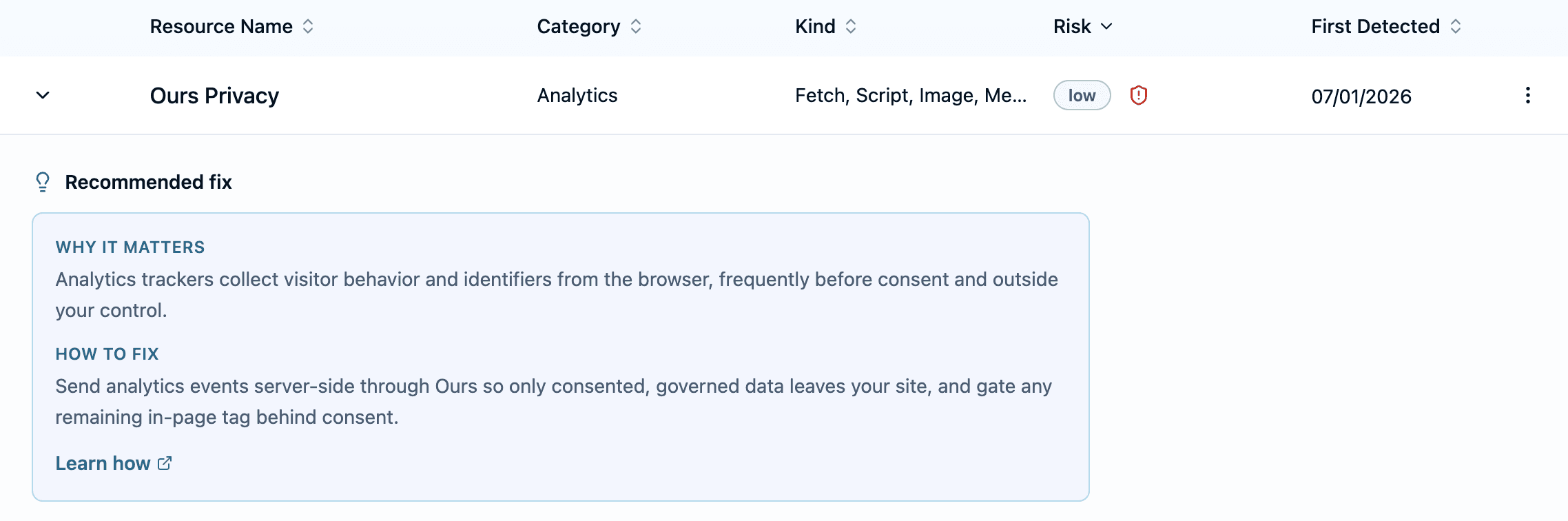
The Web Scanner already crawls your site for trackers, cookies, fingerprinting, content security gaps, leaky third-party resources, and accessibility issues. Until now it told you what it found and left the fix to you. Every finding now ships with a plain-language explanation of why it matters and a concrete recommendation for how to remediate it.
Self-hosted fonts instead of a third-party font host, a content security policy that closes the gap the scan flagged, the storage or tracker change that brings a page back into line: the guidance lives inline next to the finding, across every category the scanner reports. The scanner moves from a detector to something closer to a heads-up display for your privacy and security posture, where a CISO or agency can read a finding and act on it in the same view. Remediation docs.
More Attribution Models
We said this spring that more attribution models were coming. Two are here. Alongside first-touch, last-touch, and linear, your attribution report now offers position-based and time-decay models. Position-based weights the first and last touch heavily and spreads the rest across the middle. Time-decay weights recent touches more than older ones.
Both spread credit across every channel in the path instead of handing it to one touch and discarding the rest, and the credit ties back to return on ad spend and cost per conversion. Switch models on the same report and set the lookback window to match how long your buying journey runs. For a team spending across paid, organic, and email, that is the difference between guessing which channels carry their weight and seeing it. Attribution docs.
Usage and Delivery Notifications
You can now get alerted as your monthly tracked usage crosses thresholds you set, and when a destination starts failing to deliver. Route the alerts to email or a webhook, so a quota you are about to hit, or a destination that stopped sending, reaches you before it becomes a surprise.
What's Next
Next up is the bigger one: customer-authored transforms in the data mapper. Today you map a field and pick from a fixed set of modifications. Soon you will be able to write your own, rename a messy inbound event to your own convention, build a custom value from more than one field, and normalize data as it flows through, all without waiting on us.
This is the direction we are taking the platform. Clean, well-modeled data that you own and control is what makes a CDP a CDP rather than a loose set of connected destinations, and putting the tools to shape your data in your own hands is central to the CDP we are building toward.
If you want a walkthrough of value-based experiments or the new attribution models against your own data, book a demo.
Related Articles
Newsletter
Stay up to date
Subscribe for privacy news, feature updates, events, etc.
